
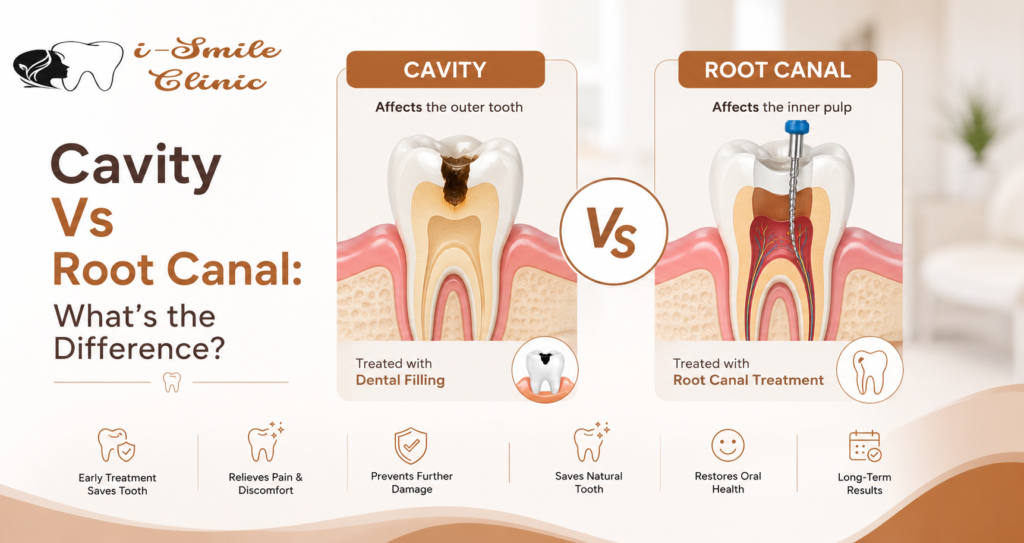
One is the beginning and the other is what happens when you ignore it.
Most root canals start as cavities. A small patch of decay that didn’t get treated, six months later it’s deeper, a year later the nerve is involved and now we’re having a very different conversation than we would have had at the start.
At i-Smile Clinic we see this more than we’d like. And every time, the patient says roughly the same thing. “I knew something was off. I just kept putting it off.”
The two procedures are completely different in what they treat, what they involve, and how long they take. Understanding the difference is the whole point of this piece.
Not the Same Problem at Different Intensities
A cavity is damage to the tooth’s outer structure. Enamel layer, maybe into the dentine underneath. The inner part of the tooth, the pulp where the nerve and blood supply live, is not involved.
We remove what’s decayed. We fill the space. You go home. Most fillings take us thirty to forty-five minutes and patients spend the next day wondering why they waited so long to come in.
A root canal is needed when decay has gone past the dentine and into the pulp. Now the nerve is involved. That’s where the pain comes from. That’s where infection develops. A filling alone can’t fix it.
We remove the infected pulp, clean and shape the canals inside the root, disinfect, seal. Usually, a crown goes on top after to protect what’s left of the tooth. Longer procedure. More involved. Completely different scale of treatment.
Same tooth but two very different situations.
Is a Root Canal More Serious Than a Cavity?
Yes. More involved, more complex, more time in the chair, usually more expensive.
But here’s the thing we want patients to actually hear: root canals are not the ordeal most people imagine. The reputation is from decades ago. Modern local anaesthesia and rotary instruments have changed what the procedure feels like enormously. We hear “that was way easier than I thought” after root canals more often than after anything else we do.
What actually makes root canals hard is infection. Active infection means inflammation, means the anaesthetic takes longer to work fully, means recovery takes longer. Patients who’ve been in pain for three months before coming in have a harder time than patients who came in when they first noticed something was wrong.
The procedure we do is the same. The starting conditions are very different.
How Do You Know If It’s a Cavity or Root Canal?
Honestly, you often can’t. Not from symptoms alone.
Early cavities have no symptoms at all. We find them on X-rays at routine check-ups, before the patient has felt a single thing. By the time cold and sweet are causing sensitivity, decay has usually moved into the dentine. By the time there’s pain without a trigger, pain that comes out of nowhere, the nerve is probably involved.
Swelling near the tooth or gum. A tooth that’s gone slightly darker. Persistent dull ache that doesn’t go away. Pain specifically when you bite down. These tell us things have moved past the cavity stage.
If any of those are present, don’t wait. Come in the same week. We’ve had patients sit with swelling for two weeks “seeing if it settles.” It doesn’t settle. It gets worse.
What Actually Determines the Treatment?
X-rays and clinical examination. That’s how we know.
We look at where the decay is, how deep it’s gone, whether there are signs of infection at the root tip, how the tooth is responding. We explain what we see before we recommend anything.
We’ve had patients come in convinced they needed a root canal and leave with a filling. We’ve had patients come in sure it was just a small cavity and find out it had gone further. The examination tells us not the symptoms.
What a Normal Age to Get Cavities Is?
Any age can get be it children, teenagers, all can get them. Adults in their forties and fifties get them for the first time as gum recession exposes root surfaces that weren’t previously at risk. We see new cavities in patients in their seventies.
There’s no age at which the risk disappears. Diet, oral hygiene, fluoride exposure, how often you come in, these things all affect it. But age alone doesn’t protect you.
Few Things Worth Doing
Come in when something changes. A new sensitivity, a new ache, a tooth that feels different than it did a month ago. Don’t wait for it to become urgent.
Don’t let fear of a root canal stop you coming in for what might just be a quick filling. We’ve had patients avoid the dentist for over a year because they feared a root canal, come in, and walk out twenty minutes later with a small filling sorted.
FAQs:
How do I know if it’s a cavity or root canal?
You probably can’t tell from symptoms. Spontaneous pain, swelling, or persistent ache means come in. We’ll tell you what’s actually happening.
Is a root canal more serious than a cavity?
More involved, yes. More frightening than it sounds, no. The anaesthetic handles the discomfort. The infection is the harder part, not the procedure.
What is a normal age to get cavities?
Any age. No stage of life is cavity-free. What changes is which surfaces are at risk and why.
Come In Before It Gets Complicated
Small cavity, quick filling. That’s the version we want for every patient. i-Smile Clinic handles both cavity treatment and root canals with proper assessment before anything is planned. If a tooth has been sending signals or it’s just been a while since your last check-up, come in and let us take a look. Almost always easier than you’re expecting.
Read More:
- How Many Sitting Required for Root Canal Treatment? Complete Guide to RCT Visits
- Efficient Endodontics | Single Sitting Root Canal Treatment
- Cavity Dental Filling: Procedure and Aftercare Guide
Visit Us: